EXPERTISE
Severe talent scarcity
High‑density GPU, liquid cooling and AI ops skills barely exist at the scale being built.
Infrastructuring Intelligence
An owner's design standard compiled into rules with clause and quote. Conflicts and gaps reported. Concept and schematic designs, with every figure traced to its source.
For data centre owners, design consultants and contractors.
The problem
Demand is exploding. The buildings cannot be designed, built or operated fast enough.
EXPERTISE
High‑density GPU, liquid cooling and AI ops skills barely exist at the scale being built.
STANDARDS
Where clauses disagree or a standard is silent, the source text stays beside the finding.
PROVENANCE
Every design figure needs a rule, a formula with named operands, or a logged decision.
TOOLING
Two toolchains, manually reconciled, neither aware of the other.
Why now
Language models read and explain. Code calculates and checks against the stated rules.
Natural language ↔ CAD ↔ digital twin is finally a viable round trip, not a research demo.
GPU density, liquid cooling and power variability demand continuous optimisation, not a one‑off design.
Governments and hyperscalers need capacity that is fast, efficient and provably compliant.
How it works
Language models read and explain. Code calculates and decides. Every figure in a deliverable comes from the calculation layer, and every one of them can be traced.
1 · The capacity
Megawatts, as IT load or at the meter
2 · Cooling
Air or liquid
3 · The site
An area, or none yet
Every other figure is proposed from Akira's practice pack, with its arithmetic and the sheet that replaces it. Nothing is written until you say so.
Your design standard becomes an executable rule set: every rule with its clause, its value and the text it was read from.
Where the standard contradicts itself, or says nothing, Akira reports it with the quote. A silence is never filled with a plausible default.
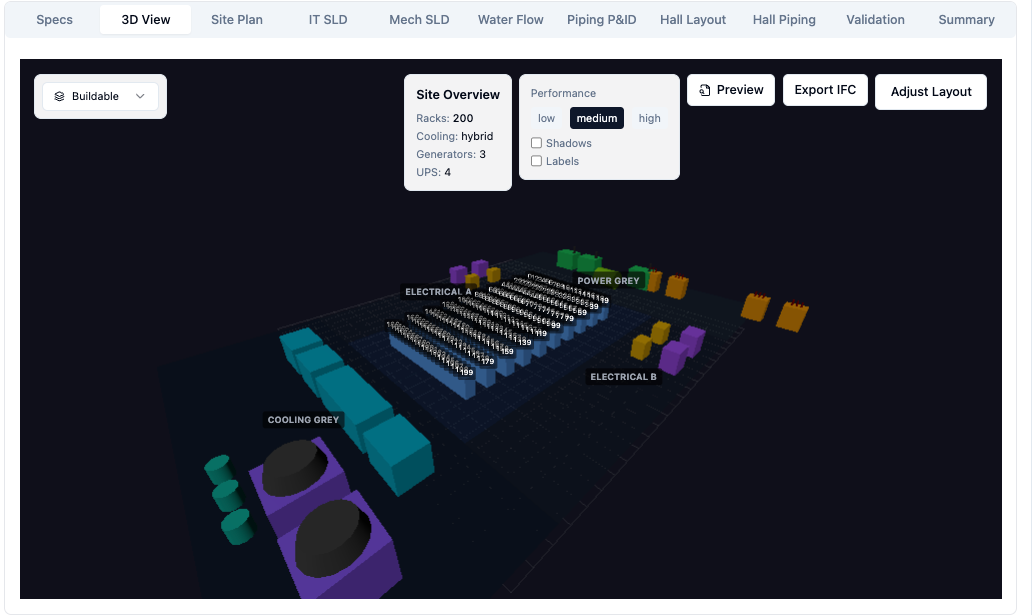
Concept and schematic design derived from the stated figures: capacity, halls, floors, plant, envelope, the discipline sheets and the IFC model.
Every check reports met, not met, review or unevaluated, with the clause it tests. Unevaluated is a state. It is never a pass.
Our solution
Natural language becomes an optimised design, and the same model keeps operating the building.
01
Generate optimised data‑center layouts straight from written requirements.
02
Agents draft work orders, show what an outage would take down and trace the impact of a maintenance window. People confirm, approve and close.
03
One model carries through build, operations and maintenance.
04
Integrates with existing CAD, BIM, DCIM and BMS. No rip and replace.
Design outputs
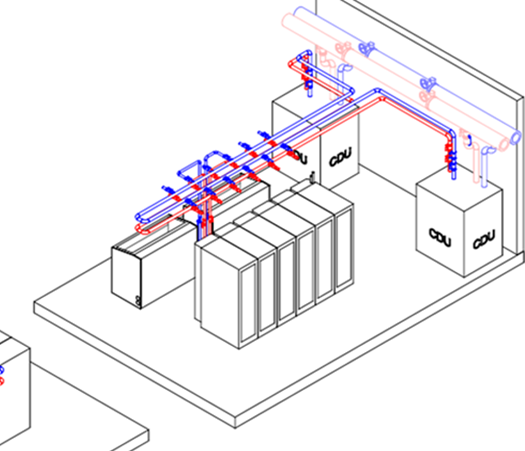
Concept and schematic designs and an LOD 300 IFC model, with every figure traced to its source.
Ask Akira
Say it in plain words. Akira composes the brief, derives the concept, builds the model and opens it, and checks every figure it places against the words it came from.
 Ask Akiramodel-written · figures tool-fetched
Composed the brief: 50 MW as IT load, air cooling, and no site yet, so a placeholder square, labelled not a site.
Derived the concept and built the model. It is open in the viewer.
Hall size and plant counts are proposed from the practice pack and marked. Nothing is written; that is your call.
Trust
A chartered engineer stakes professional liability on these outputs. Five rules hold in every module, and a change that breaks one is wrong even if every test passes.
A silent standard is reported as a gap, never filled with a plausible default.
The same inputs and the same standard give byte-identical outputs, every run.
Every value traces to a cited rule, a formula with named operands, or a logged decision.
A rule that cannot be evaluated says so, with the reason. It is never skipped.
No conflict, gap or verdict without the source text it rests on.
Who it is for
Your standard, compiled and kept as your own pack. A rule you state wins over every assumption, with your name and your reason on the record.
Concept and schematic packages derived from the brief, with every open figure listed as the work still to do rather than hidden behind a default.
Proposals and bids read against the Basis of Design, with clarification questions drafted for a reviewer to approve.
Our people
“I've spent thirty years building high‑performance and critical infrastructure systems.”
Chak Lee Meng
Founder & CEO
Kevin Gao
CTO
Tan Tian Chong
Advisor, Construction
Pua Ching Tian
Advisor, MEP
Next
Bring your design standard. We will show its rules, conflicts and gaps, and the concept and schematic designs.